A Sentinel shaped by what the field taught us.
RiceGuard Sentinel is the physical layer of the system: a solar-powered station that measures the field, processes information at the edge and maintains its own operating history. Generation 3 is installed at Ranot. Generation 4 is the concept design developed from what Generation 3 revealed in the field.
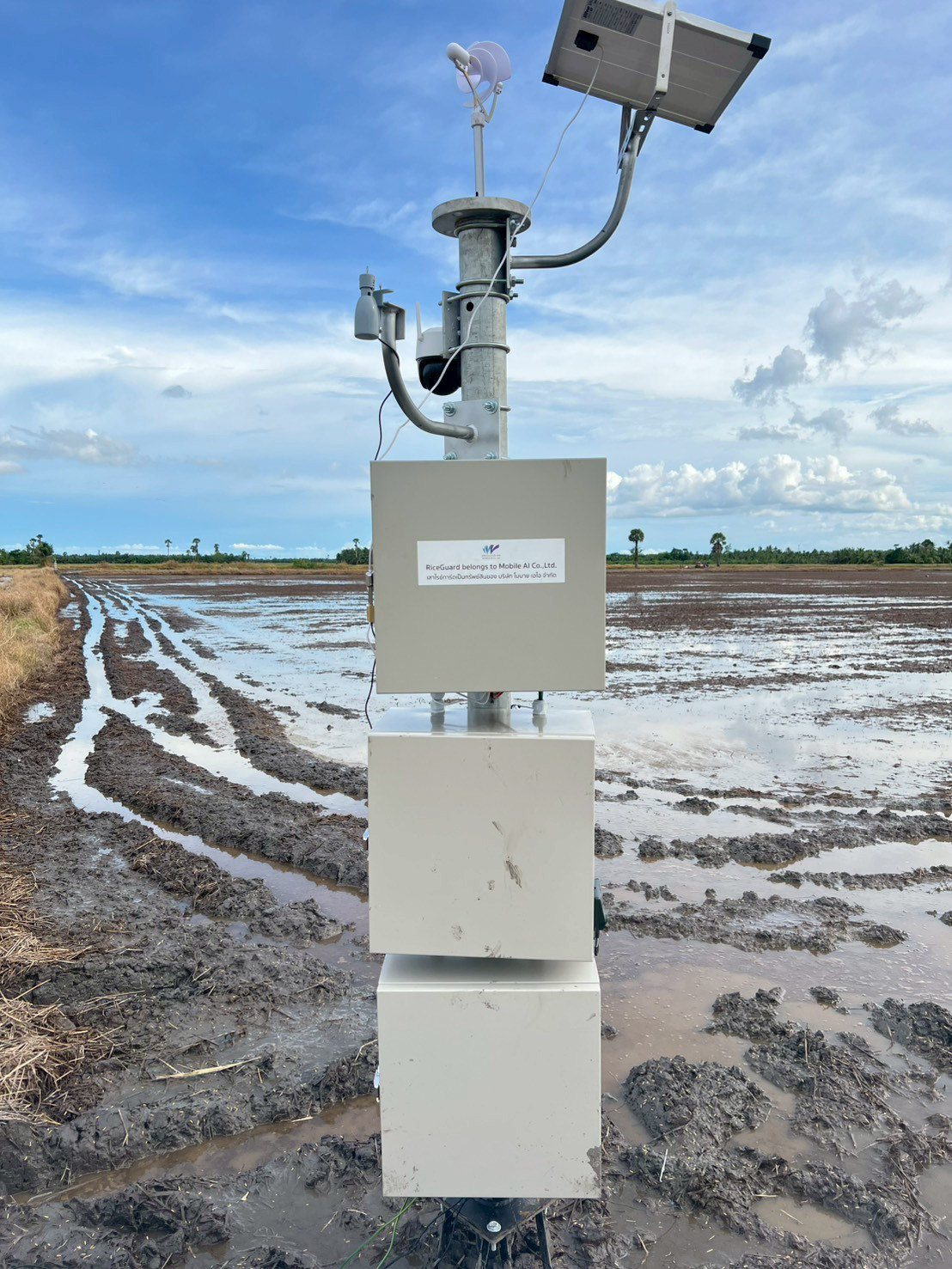
Generation 3 Deployed at Ranot
A functional form developed from field evidence.
Generation 4 keeps the 320 mm body diameter of Generation 3 and develops it into a twisted hexagonal form. The prism twists 55 degrees, narrows below mid-height and flares at the mouth and foot. The form helps keep at least one solar facet facing the sun while adding stiffness without increasing projected wind area.
Design input dated 30 July 2026 · concept information, not a released production specification
Critical systems rise above 1,900 mm.
Every critical level is set against a 1,900 mm design flood level. The electronics bay begins above that line. The critical-water float switch sits below it as an independent safety input, while the battery, power distribution and edge-compute systems are placed higher inside the body.
Design status Concept design — awaiting professional engineer sign-off
- 01 Air terminal tip 4,700 mm
- 02 Station height 4,050 mm
- 03 Butterfly panels · mid-panel 3,855 mm
- 04 Weather cluster / camera + IR 3,950 / 3,620 mm
- 05 Top of service bay B 3,230 mm
- 06 Bottom of electronics bay 1,945 mm
- 07 Design flood level 1,900 mm
- 08 Critical-water float switch 1,700 mm
- 09 Service platform / body joint 1,320 mm
- 10 Leg spread at grade 900 × 900 mm
- 11 Helical piles 2,500 mm below grade
Seventeen items placed by height—not convenience.
The internal layout follows the flood line, service access and cable route. Equipment is grouped by function so maintenance can be completed without treating the station as one undifferentiated cabinet.
- 01 Field communications
LoRaWAN, 4G LTE and gateway hardware sit high in the body to keep field links protected and serviceable.
- 02 Edge compute
The Jetson module, storage and always-on power manager are grouped on a removable service tray.
- 03 Distribution & protection
Circuit protection, current sensing, surge protection and power distribution are kept together.
- 04 Battery storage
Two slim LiFePO4 packs occupy the lower protected bay while remaining above the design flood level.
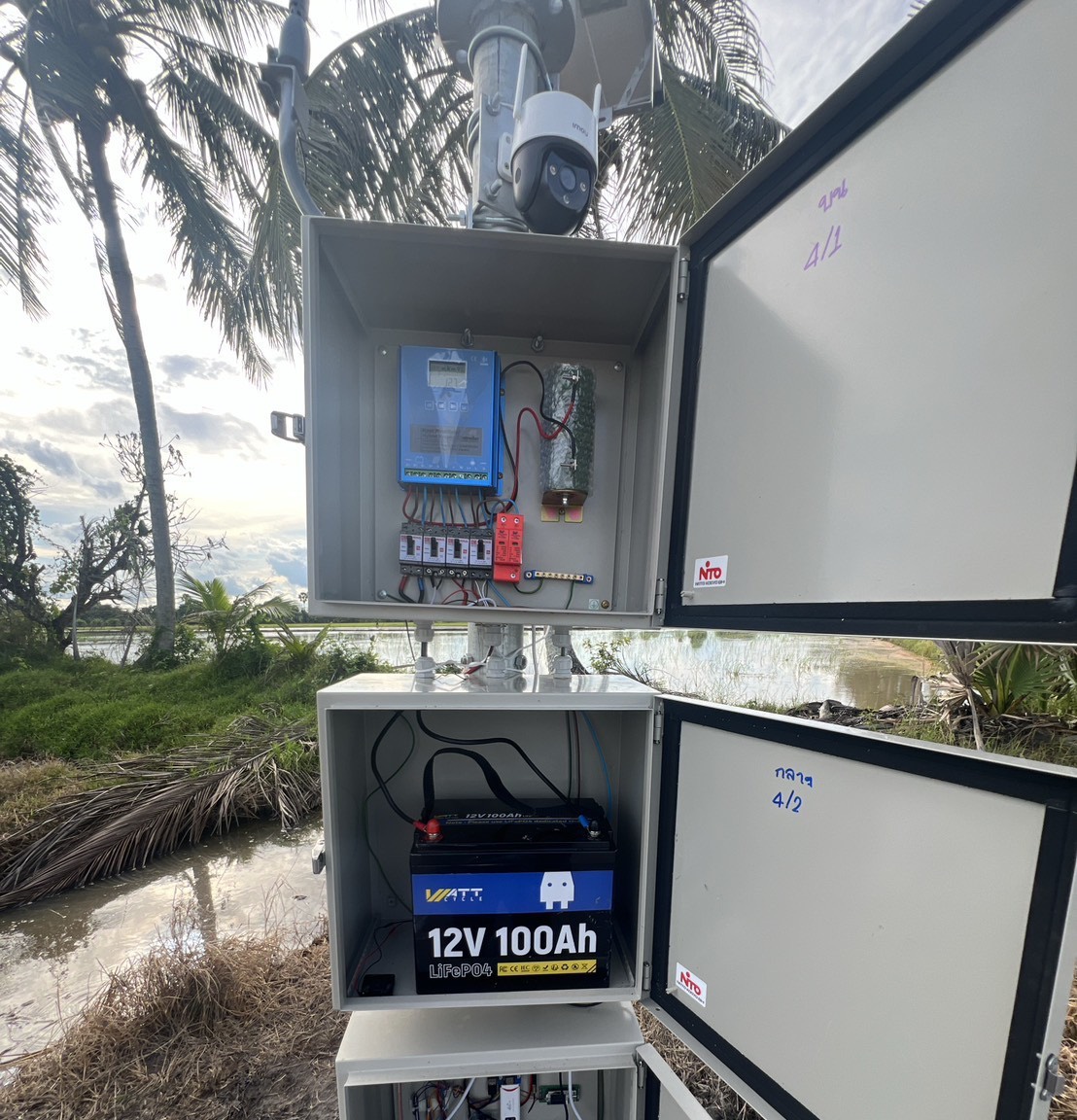
Deployed reference Generation 3 field cabinet Real installation photograph
Power and compute separated by function.
- Service bay A Battery and power
- Two slim 50 Ah LiFePO4 battery packs provide 1,200 Wh of storage. Power distribution, protection, current sensing and surge-protection equipment are grouped above them and remain above the design flood level.
- Service bay B Edge compute
- The edge computer and GPU sit on a tool-less slide-out tray so the compute module can be exchanged in the field. A door-open switch records each service access.
Eighteen measurements. One field station.
The station records agronomic conditions, its own operating health and two independent safety states. The groups below explain what the published total of eighteen represents.
- 01 One permanently buried 7-in-1 probe
Moisture, temperature, electrical conductivity, pH and N-P-K are read at root depth.
- 02 Conditions measured at the plot
Water level, air temperature, air humidity, illuminance, rainfall and wind speed describe local conditions.
- 03 Scheduled imaging plus insect activity
Two infrared cameras and an infrared insect counter provide visual and pest-related evidence.
- 04 The device monitors itself
Battery, circuit, enclosure, tilt and vibration readings show whether the station can keep operating safely.
08 Agronomic + 08 Power & health + 02 Safety = 18 measurements
Open below. Serviceable above.
The base uses an open lattice with a 900 × 900 mm leg spread so floating straw can pass through instead of collecting against the structure. Cross members serve as climbing rungs. A service platform and guard rail provide access to the body, while four removable helical piles extend 2.5 m into the ground without leaving a concrete foundation in the paddy.
Design status Generation 4 structural calculations require professional sign-off
From crown to ground.
A pointed air terminal rises above the sensors and solar panels. A 16 mm² copper down conductor follows the body and a leg to a 5/8-inch × 2.4 m ground rod with an earth test box. A Type 2 DC surge protector rated at 20 kA sits upstream of the MPPT charge controllers.
-
Air terminal
↓ -
Down conductor
↓ -
Ground rod
Design status Concept design — awaiting engineer sign-off
Solar margin shown honestly.
Wrap-around solar remains in the design, but the energy calculation shows it is not sufficient on its own. Estimated rainy-day production is about 132 Wh against a default 112 Wh daily load—a margin of 1.18×, below the 2.00× design threshold.
Adding two 200 W bifacial butterfly panels raises estimated rainy-day production to 615 Wh. The combined margin is 5.49×, corresponding to approximately eleven days of no-sun autonomy in the design calculation. Field confirmation is still required.
One specification. Clearly qualified.
All values in this section describe the Generation 4 concept design and remain subject to professional engineer sign-off.
- Power
- Bifacial 2 × 200 W plus approximately 180 Wp wrap-around solar; LiFePO4 12 V 100 Ah, 1,200 Wh
- Charge control
- Two independent MPPT controllers, at least 20 A, LiFePO4 mode, with telemetry
- Communication
- Independent LoRaWAN heartbeat plus 4G LTE
- Edge compute
- reComputer Mini J3011; Jetson Orin Nano 8 GB; 40 TOPS; 128 GB NVMe; always-on ESP32 power manager
- Instrumentation
- 18 measurements: 8 agronomic, 8 power and health, 2 safety
- Ingress protection
- IP66 overall; IP68 electronics and battery bays; IP68 soil probe
- Dimensions
- 320 mm diameter × 4,050 mm station height; 900 × 900 mm base
- Weight
- Approximately 96 kg including wrap-around laminate
Generation 3 did more than collect data. It changed the device.
- 01 Solar collection
One 200 W panel becomes two 200 W bifacial panels facing east and west.
- 02 Soil sensing
Three separate soil sensors become one permanently buried 7-in-1 probe.
- 03 Energy storage
One 24 V battery becomes two slim 50 Ah LiFePO4 battery packs.
- 04 Charge control
One controller becomes two independent MPPT controllers with telemetry.
- 05 Edge compute
The edge computer moves to a reComputer Mini J3011 with Jetson Orin Nano 8 GB.
- 06 Field link
The main link moves to 4G LTE with an independent LoRaWAN heartbeat.
Design status Generation 4 concept design — awaiting professional engineer sign-off
The device is the beginning of the data chain.
See what the Sentinel measures and how the installed system performs in the field.